Critcatenate: #critcat in January 2022

Critcatenate is an effort to keep folks up to date on #critcat efforts with a monthly roundup of news. #critcat is short for critical cataloging, focusing on the ethical implications of library metadata, cataloging, and classification standards, practice, and infrastructure.

#critcat in December 2021 and January 2022:

Upcoming:

Please get in touch if I’ve missed anything relevant, I’d be happy to add it to next month’s report!

Also: I don’t get paid for this work, so if this roundup is useful to you, please drop me a line to say thanks and/or give me a job!
Critcatenate: #critcat in November 2021

Critcatenate is an effort to keep folks up to date on #critcat efforts with a monthly roundup of news. #critcat is short for critical cataloging, focusing on the ethical implications of library metadata, cataloging, and classification standards, practice, and infrastructure.

#critcat in November 2021:

Upcoming:

  • Friday December 10: “Cataloguing and classification ethics: an ARLIS online talk” by Deborah Lee, sponsored by the ARLIS (Art Libraries Society) Cataloguing and Classification Committee, discussing the problematic design of cat and class systems, practitioner ethics, and the wider context including barriers/issues/tensions in making changes to our systems/practices.
  • Thursday December 16: “Tackling Racism and Bias in the Library Catalog,” sponsored by the Public Library Association. Featuring Paloma Celis Carbajal, Melissa Gasparotto, Amy Mikel, & Steven Pisani of New York Public Library and Brooklyn Public Library.

Please get in touch if I’ve missed anything relevant, I’d be happy to add it to next month’s report!

Recent Discussion on RadCat about racist headings

Greetings!

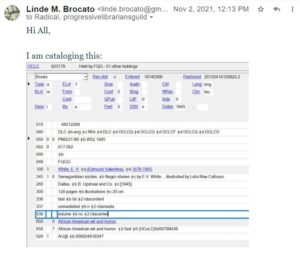
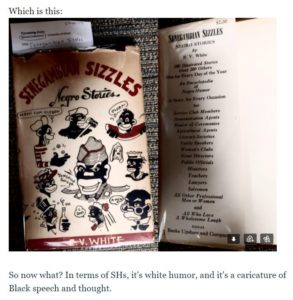
This post combines all the above, i.e. issues of subject headings and of CNs, in response to a query I posted about a fairly egregious case of racist humor and racist cataloging.

It also reveals, on further thought, the problems with the “objectivity” dictum of H180:

14. Objectivity. Avoid assigning headings that label topics or express personal value judgments regarding topics or materials. Individual cataloger knowledge and judgment inevitably play a role in assessing what is significant in a work’s contents, but headings should not be assigned that reflect a cataloger’s opinion about the contents. Consider the intent of the author or publisher and, if possible, assign headings for this orientation without being judgmental.
Follow stated intentions of the author or publisher in such matters as readership, audience level, treatment as fact or fiction, etc.”
https://www.loc.gov/aba/publications/FreeSHM/H0180.pdf

This policy disallows recognizing and signalling implicit and systemic bias and prejudicial treatment. It assumes good faith on the part of the author or publisher, and (shall we say) social good faith more generally, on the part of author, publisher, cataloging norms, and cataloger.

Neither personally nor professionally do I believe that “objectivity” has to stand within the values and perspective of the author, particularly with egregious bias and bad faith on clear display.

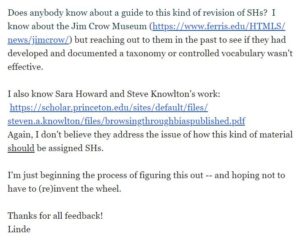
I include my original post to RadCat and Progressive Librarian’s Guild, and then include a summary of the responses within the thread:

RADCAT Responses to Brocato’s Inquiry about Racist Materials

Inquiry posted to RADCAT Tuesday 2 November 2021

 .N-cutter changes on ClassWeb: https://classweb.org/approved/2106.html

SHs

  • Blackface [since it covers all types of Blackface portrayals, including artistic and literary]
  • African Americans $v Caricatures and cartoons.
  • African Americans in literature.
  • Racism in literature.
  • Racism against Blacks.
  • and possibly the genre term 655 \7 Caricatures. $2 lcgft
  • “African Americans $v Humor” and probably “Racism $v Humor.”
  • “655_0 Racism in literature”

Michael Gorman suggested “African Americans – Racist stereotypes”, but Julie Moore pointed out that that’s not a SH, and that LCSH has used “stereotype” very cautiously:

  • Stereotypes (Social psychology)
  • Noble savage stereotype
  • Model minority stereotype
  • Strong black woman stereotype

I believe the last 2 are relatively new.

From Julie Moore at Fresno State:

I am also going to change the .O numbers (=Orientals) even though that has not officially been changed yet at LC. Being Japanese American, myself, I have always cringed (on a personal level) when I have seen the .O numbers. In most cases, for the .O numbers I can use a cutter for Asian Americans. There are also areas where I will be able to break it down further.


Activities

RBMS Controlled Vocabularies has a subgroup working on proposals for an expansion and revision to the prejudicial materials section of the vocabulary. These terms have not gone through the review process yet so cannot be used, but one of the proposals is for “Racist caricatures” and so in the future that will hopefully be an option.  They’re apparently working on expanding Prejudicial works terms, like “Blackface minstrel jokes” and “Racist caricatures.” Not sure when this will come out officially, but it’s promising-sounding, if you don’t mind using vocabularies other than LCSH (I know some libraries keep only LC-based vocabularies in bibliographic records).

Resources

Sanford Berman’s work was of course foundational: http://www.sanfordberman.org/

Dorothy Berry’s work on describing minstrelsy collections: https://www.dorothy-berry.com/minstrel-description (This is a great project and post!)

African American SACO Funnel

Another project that someone pointed me toward is Shelby Daniels-Young’s, so I reached out to her, and she responded most generously:

I’m always glad to hear about someone doing similar work! The project I’m working on is to revise the finding aid for a collection of about 500 postcards and trade cards from the late nineteenth and early twentieth centuries, nearly all of which contain stereotypes of Black people. The original finding aid used folder labels that took a more “neutral” route in the content list (“Music”, “Women”, “Children”, etc) so we’ve been working on reorganizing the collection completely and having folder names that explicitly list the types of harmful imagery found in the materials (Mammy stereotypes, Southern nostalgia, Food racism, Caricatured speech). It’s been a combination of research into the history of stereotypes and consulting the faculty members on our team, since we couldn’t find any controlled vocabularies that would do what we were looking for. I see you looked into the Jim Crow Museum–their website was one of our first points of reference.

I don’t have much to link to on my end, since this is still a work in progress, but I can certainly answer any other questions you might have and am fine with being listed as someone thinking about how to describe these types of materials.

Shelby Daniels-Young (she/her/hers)

Pauline A. Young Resident Affiliate Assistant  Librarian

Special Collections, University of Delaware Library. Museums and Press

sdanyou@udel.edu

Mark Ehlert has created a report you can run in Alma Analytics:

Alma: /Shared Folders/Community/Reports/Consorita/MNPALS/Resources & Collections. It is called “Project – .Nx Cutter Tracker (Regex)”


Practical Aspects

Be aware that the motion picture classes and the general poetry classes tend to be where you may need to do some significant shifting in the stacks.

Contributors of the above content:

  • Bobby Bothmann
  • Mark Ehlert
  • Michael Monaco
  • Deborah Tomaras
  • Julie Moore
  • Shelby Daniels-Young
  • Madeline Douglass

Critcatenate: #critcat in October 2021

Critcatenate is an effort to keep folks up to date on #critcat efforts with a monthly roundup of news. #critcat is short for critical cataloging, focusing on the ethical implications of library metadata, cataloging, and classification standards, practice, and infrastructure.

#critcat in October 2021:

Upcoming:

  • Wednesday November 3: “Authors, Authority, & Identity: Facilitating Self-Identification for Discovery & Inclusive Knowledge Production“. Part of Harvard Library’s Advancing Open Knowledge initiative, featuring speakers Amber Billey, Julia Bullard, Hannah Carton, B.M. Watson, Ciyadh Wells.
  • Tuesday November 9: Minitex (Minnesota) Technical Services Symposium happening online. The 2021 theme is “Good Trouble: Activism and Ethics in Technical Services”. Critcat sessions include:
    • “Scruples and Hoopla: Ethical principles into ethical actions” keynote by Beth Shoemaker
    • “From the Back Room to the Front Line: Integrating DEI Primary Sources for Discovery” by Faye Mazzia and Ying Zhang
    • “Demographics of Cataloging and the New White Man’s Burden” by Preston Salisbury
  • Friday November 19: “It’s All Subjective: Modern Subject Analysis” virtual fall meeting of NOTSL (Northern Ohio Technical Services Librarians). Presentations include:
    • “‘About’ Is What It’s About! The State of Subject Access” by Rocki Strader
    • “Underrepresented Collections in the Howard B. Waltz Music Library” by Linda Bagley, Clara Burns, and Kelsey A. Fuller
    • “Ghost in the MARChine: Pseudonymity and Anonymity Usage in Electronica Music Sound Recordings” by Leonard “Leo” Martin
  • Call for submissions: the next issue of Catalogue & Index will be on the topic of advocacy, very relevant to critcat interests. Consider submitting your example of advocating for more staff / resources or for the value of metadata / cataloging. Deadline November 30.

Please get in touch if I’ve missed anything relevant, I’d be happy to add it to next month’s report!

Critcatenate: #critcat in September 2021

Critcatenate is an effort to keep folks up to date on #critcat efforts with a monthly roundup of news. #critcat is short for critical cataloging, focusing on the ethical implications of library metadata, cataloging, and classification standards, practice, and infrastructure.

#critcat in September 2021:

Upcoming:

  • Monday October 4: “Metadata and DEIA” webinar from the  NISO Diversity, Equity, Inclusion, and Accessibility (DEIA) Committee featuring Treshani Perera, Merrilee Proffitt, and Brian M. Watson.
  • Minitex (Minnesota) Technical Services Symposium is happening online Tuesday November 9. The 2021 theme is “Good Trouble: Activism and Ethics in Technical Services”.

Please get in touch if I’ve missed anything relevant, I’d be happy to add it to next month’s report!

Critcatenate: #critcat in August 2021

Critcatenate is an effort to keep folks up to date on #critcat efforts with a monthly roundup of news. #critcat is short for critical cataloging, an effort focusing on discussing the ethical implications of library metadata, cataloging, and classification standards, practice, and infrastructure.

#critcat in August 2021:

Upcoming:

  • Dewey Really Need This?,” a panel exploring the Dewey Decimal System, streaming and in person, from PMI Victorian History Library in Australia. (Sunday September 19 on Australian time means this will be on Saturday September 18, 11 pm U.S. Central time.) Speakers will discuss the ethical and practical issues of Dewey classification, and how it is used or modified in different institutions today.
  • Minitex (Minnesota) Technical Services Symposium is happening online Tuesday November 9. The 2021 theme is “Good Trouble: Activism and Ethics in Technical Services”. Deadline for proposals: September 24.

Please get in touch if I’ve missed anything relevant, I’d be happy to add it to next month’s report!

Critcatenate: #critcat in July 2021

Critcatenate is an effort to keep folks up to date on #critcat efforts with a monthly roundup of news. #critcat is short for critical cataloging, an effort focusing on discussing the ethical implications of library metadata, cataloging, and classification standards, practice, and infrastructure.

Upcoming:

  • August 12: “Cataloging Queer Library Issues: A Symposium to Honor Walt ‘Cat’ Walker” is not just cataloging, but will feature cataloging and multiple other topics related to queer issues in academic libraries, including a discussion of the Homosaurus vocabulary and reorganizing Vancouver’s Out On The Shelves library. Registration is free.
  • November 9: Minitex Technical Services Symposium. This year’s theme will be “Good Trouble: Activism and Ethics in Technical Services”. The speakers will include Kenda Zellner-Smith, who preserved the artwork created in Minneapolis during the George Floyd protests, and Beth Shoemaker discussing the Cataloging Code of Ethics.

Critcatenate: #critcat in June 2021

Critcatenate is an effort to keep folks up to date on #critcat efforts with a monthly roundup of news. #critcat is short for critical cataloging, an effort focusing on discussing the ethical implications of library metadata, cataloging, and classification standards, practice, and infrastructure.

Upcoming:

  • July 7: “Decolonizing the Catalog: Anti-Racist Description Practices from Authority Records to Discovery Layers” webinar from Reference and User Services Association (RUSA) featuring these topics:
    • Elizabeth Hobart will discuss the inadequacy of current subject headings related to anti-racism and the difficulties that patrons face in locating anti-racism books in the library catalog
    • Staci Ross and Michelle Cronquist will detail their work as Co-Chairs of the African American Subject Funnel Project
    • Kelly Farrell will discuss the Triangle Research Libraries Network (TRLN) collaborative efforts to remap problematic, outdated, and offensive LC Subject Headings by “replacing” these terms in their public catalog/ discovery layer.
  • July 9-11: North American Symposium on Knowledge Organization. This year’s session topics include Topics include Indigenous knowledge systems, video game metadata, graffiti hashtags, equitable cataloging, fiction genres, and more.
  • July 19-23: 2021 LD4 Conference on Linked Data. Registration is free; critcat-relevant sessions include “Is User-Centered Design in Conflict with Cataloging Ethics?” presentation by Peggy Griesinger, Mikala Narlock, and Hanna Bertoldi, discussing the tension between creator privacy and user needs, as well as a discussion and workshop on “Queering the Linked Data Universe: Word- and World-defining with the Homosaurus” from Bri Watson.
  • July 26-30. ALA Core Virtual Interest Group Week. Sessions will happen all week, with two critcat-related sessions on July 28: the Cataloging and Classification Research Interest Group (CCRIG) will feature presentations on the theme “Ethical Cataloging: Toward Diversity and Inclusiveness” and the Metadata Interest Group will feature presentations on the topic of library metadata & EDI (equity, diversity, and inclusion).
  • August 12: “Cataloging Queer Library Issues: A Symposium to Honor Walt ‘Cat’ Walker” is not just cataloging, but will feature cataloging and multiple other topics related to queer issues in academic libraries. Stay tuned for more info about session content.

Please get in touch if I’ve missed anything relevant, I’d be happy to add it to next month’s report!

Critcatenate: #critcat in May 2021

Critcatenate is an effort to keep folks up to date on #critcat efforts with a monthly roundup of news. #critcat is short for critical cataloging, an effort focusing on discussing the ethical implications of library metadata, cataloging, and classification standards, practice, and infrastructure.

Upcoming:

  • June 18 2021: OCLC Cataloging Community Virtual Meeting includes a session on Diversity, Equity and Inclusion in Metadata, including these topics:
    • Inclusive Description at the Rare Book and Manuscript Library from Celeste L Brewer, Yingwen Huang, and Kevin W. Schlottmann
    • update on the Mellon Grant to reimagine descriptive workflows from Jennifer W. Baxmeyer
    • Remapping LC subject headings in TRLN discovery from Cory Lown and Lynn Whittenberger

Please get in touch if I’ve missed anything relevant, I’d be happy to add it to next month’s report!

Critcatenate: #critcat in April 2021

Hello! I am trying out a new idea for keeping folks up to date on #critcat efforts with a monthly roundup of news. #critcat is short for critical cataloging, an effort focusing on discussing the ethical implications of library metadata, cataloging, and classification standards, practice, and infrastructure. (Critcatenate = “critcat” + “concatenate.”)

  • The recording of the March 2021 webinar “Decolonizing Subject Headings and Collections part 2” is now available. Presenters Ann Hallyburton and Paromita Biswas answered questions from the audience focusing on practical aspects of addressing biases within cataloging and libraries.
  • Multiple papers within the March 2021 issue of Catalogue & Index (published by CILIP’s Metadata & Discovery Group) touch on critcat topics:
    • “Sizeist subjects: an investigation into sizeism in Library of Congress Subject Headings” by R. M. Waldorf & Jonathan Furner.
    • “Making change that matters in the library catalog” by Laura E. Daniels, Jacqueline K. Magagnosc, and Margaret F. Nichols on the “Illegal aliens” LCSH.
    • “Controlled vocabulary and authorities: problems everywhere” by Preston Salisbury and Joy DuBose, featuring challenges in maintaining & updating LCSH and lack of resources in cataloging efforts & training.
    • “Collaborative working across the Atlantic: participating in the Subject Headings Working Group of the Cataloguing Code of Ethics” by Jennie-Claire Crate, describing the document’s creation/editing process.
    • “The ethics of describing images: representing racial identities in photographic collections” by Paula Jeannet.
    • “The Homosaurus” by Bri Watson, Chloe Noland, and Amber Billey is a description of how the LGBTQ+ thesaurus is maintained.
  • A list of institutions making critcat-related changes was compiled by Helen Kim.
  • A blog post from Ariel Robinson at the Chicago History Museum Research Center describes “Creating a Disability Studies LibGuide” as part of the museum’s ongoing critcat efforts.
  • OCLC announced a new project named “Reimagine Descriptive Workflows,” designed to “interrogate the systems and structures libraries and archives rely on and to initiate reckoning with this painful history.”
  • Librarians at multiple California community colleges published a post about their efforts to remove offensive words from their shared library catalog, including the “Illegal aliens” LCSH: “Changing Subjects: Two DEI Metadata Projects at CCC Libraries“. Their work also led to a stoplist of offensive terms in all Primo VE environments.
  • Alissa McCulloch wrote a fascinating blog post describing problems wit the way a book by Indigenous Australians had been cataloged and suggesting alternative ways to design library catalogs: “Cataloguing the Songlines“.
  • OhioLink shared the work done in their consortial catalog around the “Illegal aliens” heading, “OhioLINK adds alternative subject headings to Central Catalog MARC records“. I’d also recommend their Database Improvement and Discoverability Policy Team’s “Guidelines for Addressing Outdated or Offensive Subject Terms” for considerations in changing subject headings in a consortium.
  • Kelsey George and Amanda Melilli presented “What’s in a Name?: The Impact of LGBTQIA+ Terminology in the Discovery of Inclusive Fiction for Young People in Curriculum Material Collections” at ACRL 2021.

Coming up:

  • May 19-21: multiple critcat-related sessions at CAPAL21:
    • May 19 “Confronting History and Facing Reality: The Role of Lifelong Learning in Decolonizing Cataloguing and Name Authority Control” presentation by Jeanine Berroteran
    • May 19 “Indian in the Metadata: Unpacking Student Relationships with Terminology in Library of Congress Subject Headings” presentation by Christian Isbiste
    • May 19 “Classifying Diversity: Composer Identities and the Composer Diversity Database” presentation by Gavin Goodwin
    • May 20 “Desire in Sight: The Aesthetics of Knowledge Organization” panel discussion with Melissa Adler, Marni James, & Gregory Nightengale
  • May 20: “Towards More Equitable, Diverse, and Inclusive Representation in Metadata and Digitization: A Case Study” presentation at NASIG 2021 by Stephanie Luke, Sara Pezzoni, and Whitney Russell.

Please get in touch if I’ve missed anything relevant, I’d be happy to add it to next month’s report!